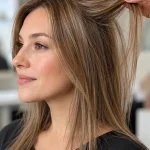
How to Style Fine Hair So It Doesn’t Fall Flat
Fine hair has a way of looking beautiful in the mirror and completely different two hours later. The roots settle against your scalp, the crown loses its shape, and the soft movement you worked so hard to create seems to disappear.
Adding more hairspray isn’t always the solution. Sometimes the problem starts with how your hair dries. Other times, it’s the products you’re using, the placement of your part, or a haircut that isn’t working with your natural texture.
The trick is to understand when your hair goes flat and what causes it. A style that collapses immediately after blow-drying needs a different solution from one that gradually loses volume throughout the afternoon.
Here’s how to identify what’s happening and make practical adjustments that can help your fine hair hold its shape without excessive products, teasing, or heat.
Why Fine Hair Falls Flat So Easily
Fine hair has a smaller individual strand diameter than medium or coarse hair. This doesn’t necessarily mean you have less hair, but it can affect how your hairstyle looks and behaves.
Hair with fine strands may lie close to the scalp, especially when it’s straight or naturally smooth. Oil, product residue, moisture, and the weight of longer hair can also influence its appearance.
The most useful place to start is with the timing of your volume problem.
Identify your flat-hair pattern
| When your hair goes flat | What could be happening | First adjustment to try |
|---|---|---|
| Immediately after blow-drying | Roots dried in a downward direction | Change your drying technique |
| Within one or two hours | Styling support may be insufficient | Test a lightweight root product |
| Around lunchtime | Scalp oil, humidity, or touching | Check oil buildup and reduce handling |
| After sleeping | Hair has settled into a flattened shape | Refresh the crown and change your part |
| After applying products | Formulas may be too heavy | Reduce the amount or number of products |
| After a recent haircut | Weight distribution or layers may not suit your hair | Review the shape with your hairstylist |
These are possible explanations rather than guaranteed diagnoses. More than one factor may be affecting your hair at the same time.
Problem 1: Your Hair Looks Flat Immediately After Blow-Drying
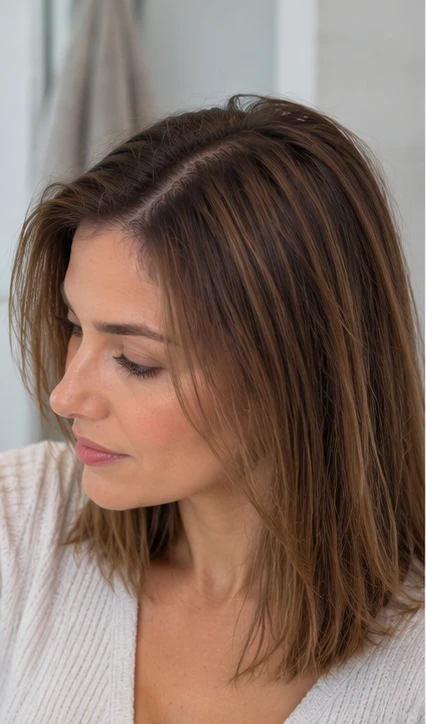
The roots never seem to lift, even when the rest of your hair looks smooth.
A polished blowout and a voluminous blowout aren’t necessarily the same thing.
When you repeatedly brush your hair downward while drying, you encourage it to lie smoothly against your head. That’s useful if you want a sleek result, but it may not create the root lift you’re hoping for.
Try changing your root direction
Begin by gently removing excess water with a soft towel. Allow your hair to air-dry partially when practical.
Separate a small section around the crown and lift it gently away from your scalp.
When using a hair dryer, keep it moving, choose a low or medium heat setting, and use a heat-protective product suitable for your hair.
Direct the airflow toward the lifted section without pulling tightly. Once dry, allow the section to cool before arranging it in place.
Repeat only where extra shape is needed.
You don’t need to lift every strand. Concentrating on the crown and front sections may be enough to change your hairstyle’s silhouette.
The difference to look for: Your roots should sit a little farther from the scalp while the lengths remain soft and movable.
The American Academy of Dermatology recommends limiting heat exposure and using gentler settings to reduce potential hair damage.
Problem 2: Your Roots Look Good, but the Volume Disappears Before Lunch
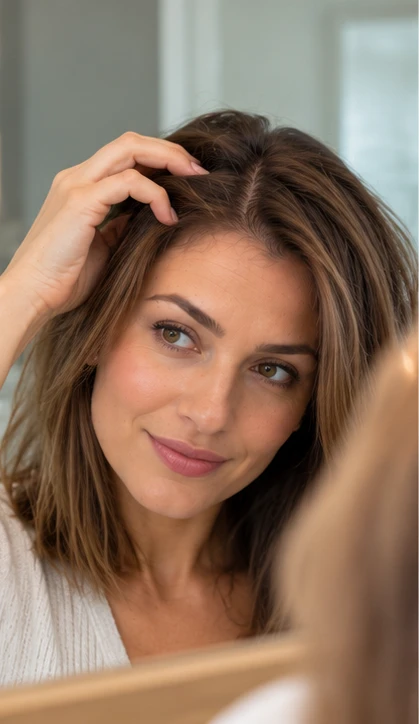
Your hair looks fuller when you leave home, but the crown gradually settles.
This is a common styling frustration, but it doesn’t necessarily mean you need stronger hairspray.
First, consider what happens to your hair after styling.
Do you regularly tuck it behind your ears? Run your fingers through the crown? Brush it repeatedly throughout the morning?
These habits can disturb the shape you’ve created.
Make the roots the focus
Instead of coating every strand in styling product, concentrate on the areas where you want lift.
A lightweight volumizing mousse or root spray may provide some temporary styling support. Start with a small amount and follow the product directions.
You can also experiment with changing the direction of your part.
For example, if your hair naturally falls to the right, try a slightly different part to see whether the roots settle with more lift.
You don’t need to move your part dramatically. Even a subtle adjustment can change the way the hair sits.
What to avoid
Adding product repeatedly throughout the day may leave your hair feeling sticky or coated.
If your hair looks flat because of oil or buildup, another layer of styling product may not help.
Pay attention to the actual condition of your roots before deciding what to apply.
Problem 3: Your Fine Hair Looks Greasy and Separated by the Afternoon
Fine hair can appear stringy when strands gather into small sections.
Excess scalp oil, some styling products, and repeated touching may contribute to this appearance.
The solution depends on whether your scalp is oily, your hair is overloaded with products, or both.
Check your product placement
Heavy oils and creams may be useful for certain hair textures, but applying too much near the roots can leave straight, fine hair looking flat.
If you use a leave-in conditioner or serum, try applying it only where you need it, usually through the lengths and ends.
For scalp cleansing, wash according to how frequently your hair becomes oily or dirty.
The American Academy of Dermatology notes that people with straight hair and oily scalps may need to shampoo more frequently than people with dry or textured hair.
Can dry shampoo help?
Dry shampoo can temporarily absorb some surface oil, which may make roots look less greasy.
However, it doesn’t replace washing with water and shampoo.
Apply only as directed, avoid excessive buildup, and discontinue a product if it irritates your scalp.
Try this: Before buying another styling product, spend a few days observing when your roots become oily. You may discover that adjusting your cleansing schedule makes a bigger difference than adding more volume spray.
Problem 4: Your Styling Products Make Fine Hair Look Even Flatter
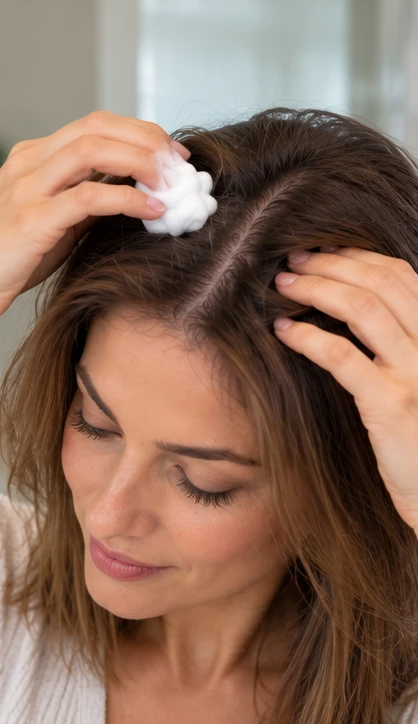
The temptation to use more product increases when your hairstyle refuses to cooperate.
You might start with a leave-in conditioner, add a smoothing cream, apply mousse, and finish with hairspray.
Individually, those products may work well. Together, they may leave some fine hair types feeling coated or lacking movement.
Give every product a purpose
Rather than using several styling formulas automatically, decide what your hair actually needs.
| Your goal | Product category to consider | Where to start |
|---|---|---|
| Lightweight root support | Volumizing mousse or root spray | Crown and root areas |
| Less tangling | Lightweight conditioner or detangler | Areas that need conditioning |
| Heat protection | Suitable heat-protective product | Sections exposed to heat |
| Temporary oil absorption | Dry shampoo | Oily root areas, as directed |
| Frizz control | Lightweight smoothing formula | Small amount through frizzy lengths |
Product results vary by formulation, hair texture, and the amount applied.
Start with fewer products and introduce changes individually.
If one formula makes your hair stiff, greasy, or difficult to brush, it may not be suitable for your routine.
There is no need to use every product category listed above.
Problem 5: Your Hair Looks Flat After Sleeping
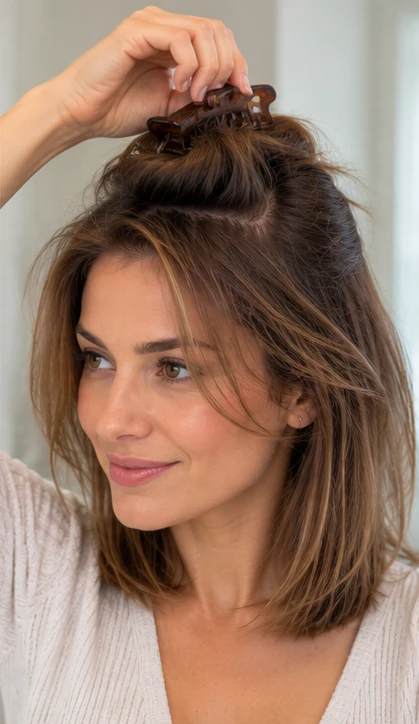
Your hairstyle can look completely different the morning after a wash.
Pillow friction, your sleeping position, and the way your hair settles overnight may affect its shape.
You don’t necessarily need to rewash everything.
A gentle morning crown refresh
Start by removing tangles gently.
Use your fingertips to adjust your part and lift a small section around the crown.
If your roots are oily, a modest amount of dry shampoo may help.
If they’re clean but simply sitting flat, try changing your part or briefly securing a loose crown section with a lightweight clip while you get ready.
Release the clip and use your fingertips to arrange the hair.
Avoid tight clips, forceful pulling, or repeated brushing.
For naturally wavy fine hair: Instead of brushing out your waves, try gently reshaping the sections with your fingers. Brushing may separate the wave pattern and create unwanted frizz.
This won’t reproduce a salon blowout, but it can make your hairstyle look more intentional without restarting your entire routine.
Problem 6: Your Haircut Makes Your Fine Hair Look Flatter
Sometimes you can follow a thoughtful styling routine and still struggle to create the fullness you want.
The reason may be the shape of your haircut.
Long hair can have a different weight distribution from a short bob. Excessive layering may also remove too much fullness from the ends, especially if your hair has relatively low density.
A haircut doesn’t increase the number of strands growing from your scalp, but it can change how those strands are arranged.
If your ends look thin: Consider a more defined perimeter
A blunt bob or a long bob with a relatively strong cutting line may make fine ends appear fuller.
The goal is to preserve visible density around the bottom rather than creating too many disconnected layers.
Explore these short bob hairstyles for thin fine hair before your next salon appointment.
If your crown looks flat: Consider controlled layering
Subtle layers around the crown can sometimes create movement, depending on your natural hair texture.
Ask your hairstylist to explain where layers will remove weight and how much hair will remain around the perimeter.
If longer hair is difficult to style: Consider a shorter shape
Shorter cuts can be easier to arrange and may reduce the time needed to create your preferred silhouette.
A pixie with a textured top or a chin-length bob might be worth considering.
Browse these short pixie haircuts for fine hair and chin-length bob ideas for fine hair for inspiration.
A Fine Hair Styling Routine for Different Mornings

Not every morning calls for the same amount of styling.
Instead of following one rigid routine, choose an approach based on your time and the condition of your hair.
The quick morning refresh
Best for hair that’s already clean but has lost its shape overnight.
- Gently detangle if needed.
- Change your part slightly.
- Lift the crown with your fingertips.
- Rearrange the face-framing sections.
- Leave the hair alone once you’re happy with the shape.
The styling-product refresh
Best for hair that needs modest temporary support.
- Check whether the roots are oily or simply flat.
- Use a suitable lightweight product only if needed.
- Apply it according to the instructions.
- Arrange the crown without aggressive brushing.
The full restyling session
Best for a wash day or an occasion when you want a more defined hairstyle.
- Cleanse and condition according to your hair type.
- Remove excess water gently.
- Apply appropriate styling and heat-protective products.
- Let the hair partially air-dry where practical.
- Use controlled, gentle styling to create the desired root direction.
- Allow the hair to settle before touching it repeatedly.
Regular high-heat styling isn’t necessary to maintain healthy-looking fine hair. On days when you don’t need a blowout, consider heat-free methods.
Three Styling Habits Worth Reconsidering
Some common beauty advice isn’t particularly helpful for fine or fragile hair.
Brushing your hair repeatedly to create fullness
Aggressive brushing can increase friction and contribute to breakage.
Brush only as needed for detangling and styling. Use gentle movements and avoid pulling.
Teasing the roots every morning
Backcombing may temporarily create height, but repeated aggressive teasing and difficult detangling can stress the hair shaft.
If you enjoy the appearance of a fuller crown, try adjusting the root direction or choosing a haircut that creates a similar silhouette with less manipulation.
Using higher heat when your style won’t hold
More heat doesn’t automatically produce longer-lasting volume.
Excessive heat can damage the hair, particularly when combined with repeated pulling or frequent styling.
Choose gentler heat settings and protect your strands instead of continuously increasing the temperature.
What Fuller-Looking Fine Hair Can Actually Look Like
Fuller-looking hair doesn’t need to be dramatic.
Sometimes the most flattering result is a softly lifted crown, healthy-looking ends, and a little movement around the face.
A shoulder-length bob might only need a slight change in the part. A pixie might look fuller with subtle texture around the top. Fine waves may need less handling, not more product.
The objective is to find a hairstyle that looks good beyond the first few minutes after styling.
You can explore our hairstyles for fine wavy hair for ideas that work with natural movement.
When Flat Hair Might Be More Than a Styling Problem
There’s a difference between hair that naturally lies flat and hair that has become noticeably thinner.
If you’ve always had fine strands, your styling concerns may simply be related to texture and shape.
However, if you’re noticing an increasingly visible scalp, a progressively widening part, sudden shedding, or new bald patches, a styling tutorial can’t determine the cause.
Hair density changes can have multiple explanations.
A dermatologist can examine your hair and scalp and recommend appropriate next steps.
Avoid assuming that a volumizing shampoo, supplement, or particular haircut can treat an underlying hair-loss condition.
Frequently Asked Questions
Why does my fine hair go flat so quickly?
Fine hair may lose its styled shape because of natural strand characteristics, root direction, excess oil, product weight, humidity, or handling. Identifying when it becomes flat helps you choose a more targeted styling adjustment.
How can I keep volume in fine hair without hairspray?
Try using fewer heavy products, adjusting your part, allowing styled roots to cool, and choosing a haircut that works with your natural texture. Some people also find lightweight mousse useful.
Does fine hair always need layers?
No. Layers can create movement, but a strong perimeter may be more flattering if your ends already look sparse. The appropriate cut depends on density, texture, length, and personal preference.
Can I style fine hair every day?
Gentle daily styling may be suitable, but excessive heat, aggressive brushing, and repeated pulling can cause damage. Use the least manipulation necessary to achieve the appearance you want.
Why does my fine hair look better the day I wash it?
Freshly washed hair may have less scalp oil and product residue weighing it down. However, results vary, and some hair types are easier to style between washes.
The Secret Is Fixing the Right Problem
Fine hair doesn’t need a complicated collection of products to look polished and full of movement.
If your roots collapse immediately after drying, start with your styling direction. If volume disappears throughout the day, examine product weight, oil, and handling. If your hair has always struggled to hold a particular shape, a different haircut may be worth discussing with your stylist.
Make one change at a time and pay attention to the results.
The most useful routine is one that fits your natural texture, keeps your strands comfortable, and doesn’t require constant restyling.
Sources and Further Reading
- American Academy of Dermatology — Tips for Healthy Hair
- American Academy of Dermatology — How to Stop Damaging Your Hair
- American Academy of Dermatology — Hair Styling Without Damage
- American Academy of Dermatology — Hair Loss: Tips for Managing
Editorial note: This article provides general hair-care advice rather than individualized medical guidance. The accompanying AI-generated images illustrate techniques and are not evidence of tested results.