Haircut Terminology Explained: What to Ask Your Stylist
A little note: Some images in this article are AI-generated to illustrate hairstyle ideas. Actual cuts, textures, colors, and styling results may differ depending on individual hair characteristics and professional techniques. Visit our Image Credits Policy for more information.
You show your hairstylist a photograph of a softly layered haircut and ask for something similar. They mention graduation, removing weight, and texturizing the ends. You nod along, assuming you’re both picturing the same thing.
An hour later, the haircut is shorter or more layered than you expected.
Sometimes this happens because you and your stylist understood the same words differently.
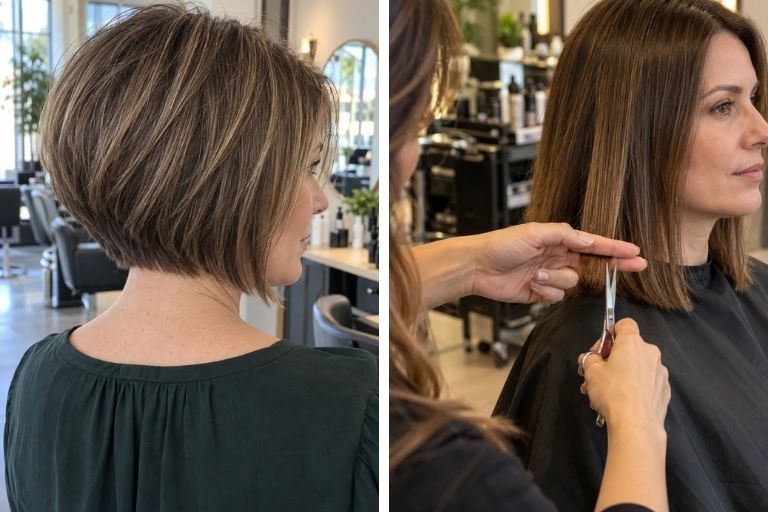
Haircutting has its own vocabulary. Terms such as blunt, graduated, tapered, and point cut describe how a stylist creates shape, controls weight, or finishes the ends. They aren’t just fancy names for hairstyles.
Understanding a few of these terms can make your next salon appointment much easier.
You don’t need to learn how to cut hair yourself. You simply need to recognize what your stylist is suggesting, understand how it could change the finished look, and know which questions to ask before the scissors come out.
The Five Haircut Terms Worth Learning First
If you only remember a handful of terms, make them these five.
| Term | Plain-English Meaning | Why It Matters |
|---|---|---|
| Blunt cut | Hair falls into a defined, relatively even-looking bottom line | Determines how full and sharp the ends appear |
| Layers | Sections are cut to different lengths | Changes movement, shape, and weight distribution |
| Graduation | Hair builds gradually from shorter to longer sections | Creates a stacked or structured shape |
| Texturizing | Techniques that alter or soften the hair’s weight and ends | Changes how a haircut separates and moves |
| Perimeter | The visible outer cutting line of the hairstyle | Determines the outline and apparent fullness at the ends |
These are the building blocks of many popular haircuts.
A bob might have a blunt perimeter with subtle internal layers. A pixie could combine graduation at the back with texture through the top. A long haircut might preserve its perimeter while adding face-framing layers.
Once you understand these combinations, hairstyle photographs become much easier to discuss.
Blunt Cut: What Does One Length Really Mean?
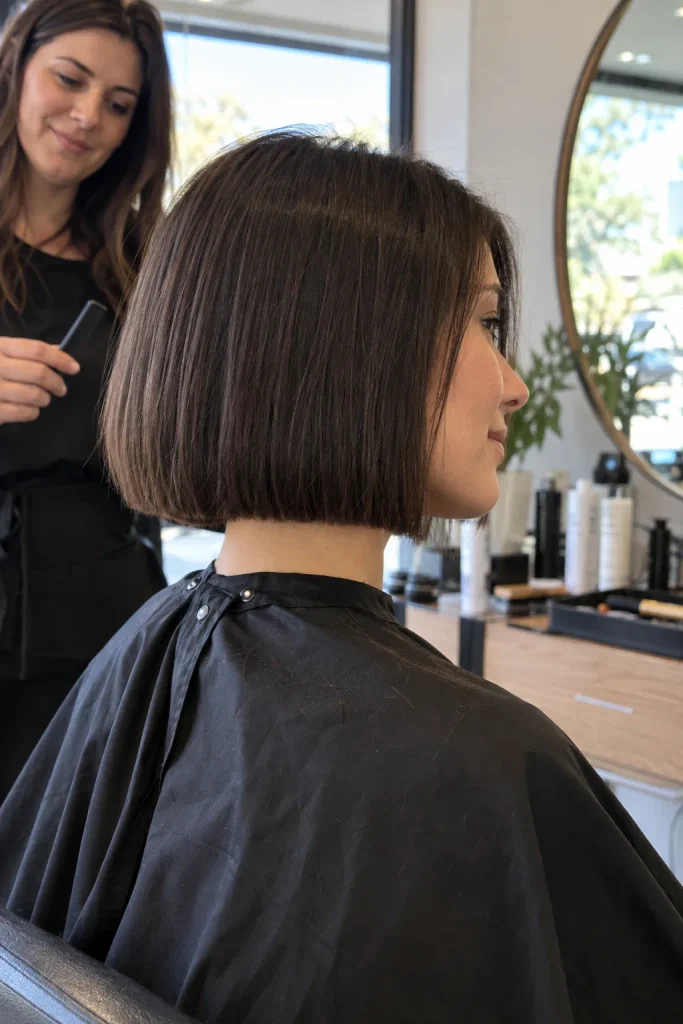
A blunt cut creates a strong, clearly defined edge.
In a classic one-length haircut, the hair falls to a common level, creating what hairstylists call a weight line.
That doesn’t mean every individual strand has exactly the same physical length from root to tip. Hair grows from different parts of the head, so the strands need different actual lengths to reach the same visible cutting line.
This distinction explains why a blunt bob looks so clean around the bottom.
What Does a Blunt Cut Look Like?
Imagine a bob ending just below the chin.
Rather than having many short pieces around the bottom, most of the hair contributes to a defined outline.
The effect can appear sleek, structured, or substantial.
Blunt cuts are especially popular for bobs and lobs, but you can also have a blunt perimeter on long hair.
Is a Blunt Cut Good for Fine Hair?
It can be.
Because more hair reaches the visible cutting line, the ends may appear fuller than they would in a heavily layered haircut.
However, strand diameter, density, natural texture, and hair condition also affect the result.
A blunt cut doesn’t physically thicken your hair.
What to Ask Your Stylist
“I’d like a clean, blunt perimeter and want to keep the ends looking full. Can we avoid adding too many layers?”
If you want some movement, you can also ask whether subtle internal layers would preserve the overall shape.
Layers: What Your Stylist Means by Adding Movement
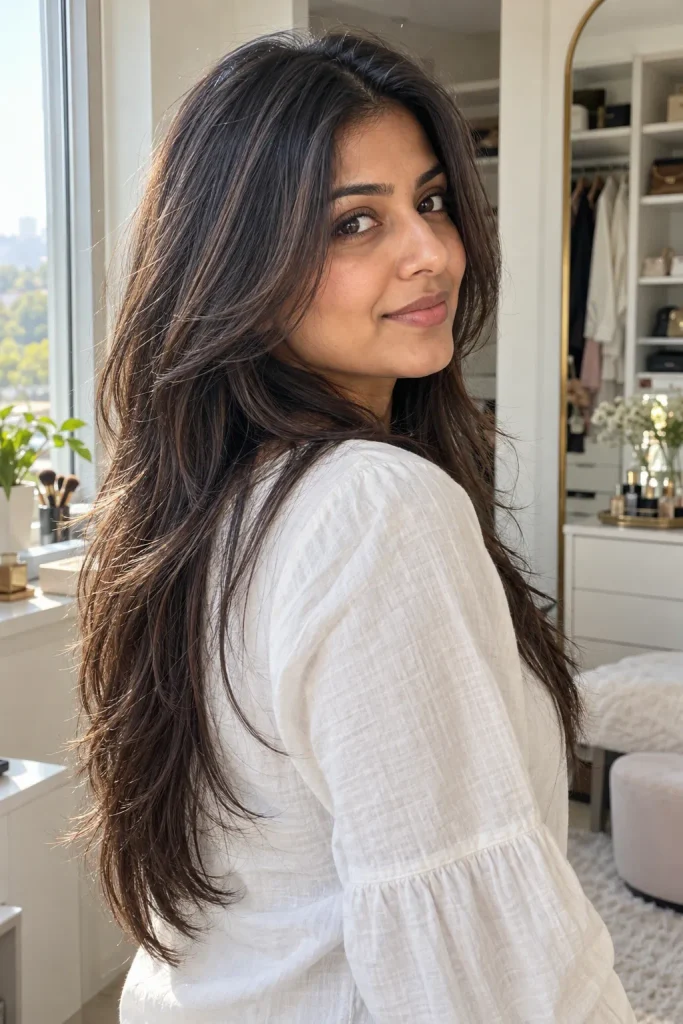
Layers are sections of hair cut to different lengths.
Instead of every strand contributing to the same visible perimeter, some strands end higher within the hairstyle.
This changes where weight sits and how the hair moves.
Layering can make a haircut feel lighter, create shape, or help natural waves and curls sit differently.
However, layers don’t automatically create volume.
The result depends on their length, placement, and the density of your hair.
Long Layers
Long layers generally preserve much of the overall length while introducing differences toward the lower sections.
They’re often used when someone wants movement without making the haircut look dramatically shorter.
For example, a long haircut may retain its length at the back while incorporating softer pieces through the lower half.
Short Layers
Short layers are cut higher within the hairstyle.
They can create more noticeable separation and change the silhouette around the crown.
But short layers aren’t automatically suitable for every hair type.
On lower-density hair, excessive layering can sometimes make the ends look sparse.
Face-Framing Layers
Face-framing layers are shorter sections placed around the front of the hairstyle.
They may begin near the cheekbones, jaw, chin, or lower, depending on the intended look.
Their purpose is to influence how the hair falls around the face.
They don’t necessarily change the overall length at the back.
Internal Layers
Internal layers are placed within the haircut rather than forming obvious, stepped layers across the surface.
A stylist may use them to adjust movement or weight while preserving more of the outer silhouette.
The result depends on the cutting technique and hair characteristics.
How to Describe the Layers You Want
Don’t simply ask for “a lot of layers.”
Instead, explain where you want movement.
You might say:
“I want to keep my overall length, but I’d like soft layers through the lower sections. I don’t want short pieces around the crown.”
That gives your stylist a clearer idea of both your preferences and your boundaries.
Graduation: Understanding the Stacked Shape
Graduation is a cutting method that creates a progression from shorter to longer hair.
It’s commonly used to build weight and structure within a haircut.
Think of a graduated bob.
The hair near the nape may be shorter, with sections increasing in length higher up the head.
This can create a rounded or stacked shape at the back.
Graduation Versus Layers
These terms are related, but they describe different weight-distribution approaches.
A graduated haircut often builds visible weight in a particular area.
A layered haircut generally removes or redistributes weight by introducing different lengths.
A single hairstyle can contain both techniques.
For example, a bob might have graduation through the back and softer layers around the front.
What Is a Stacked Bob?
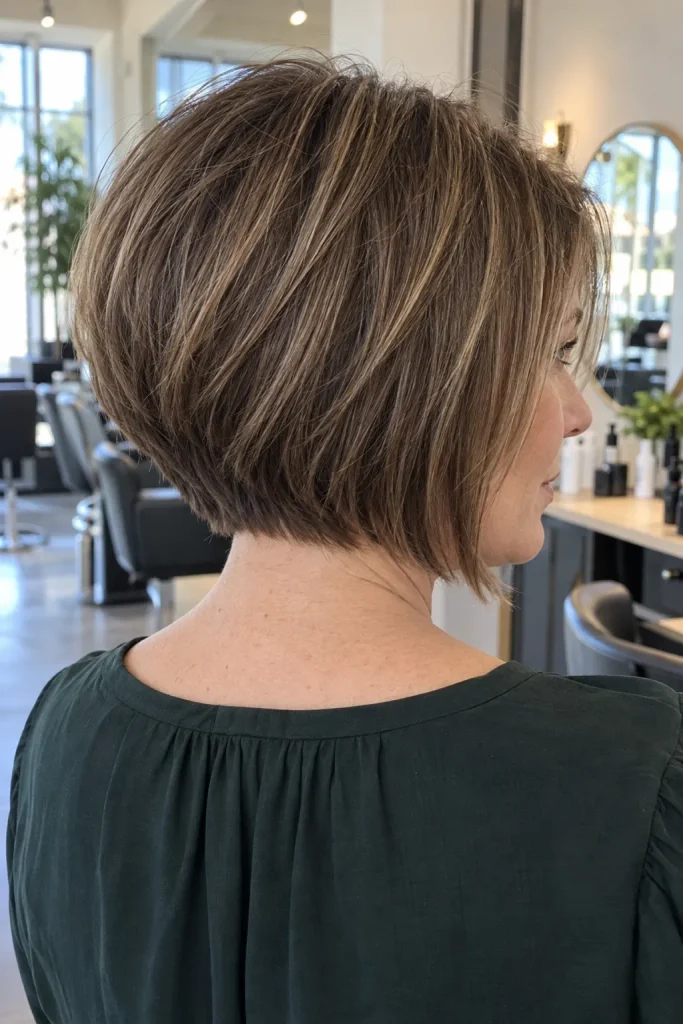
A stacked bob uses graduation to create structure, usually toward the back of the head.
The short sections near the nape support a rounded silhouette above them.
The exact shape depends on the degree of graduation, overall length, and how the stylist connects the sections.
Questions Worth Asking
“How much graduation will you add at the back?”
“Will the back look noticeably stacked or only slightly rounded?”
“How will the haircut look as it grows?”
These questions are particularly useful if you’re considering a sharply shaped short bob.
Texturizing: What Happens When a Stylist Removes Weight?
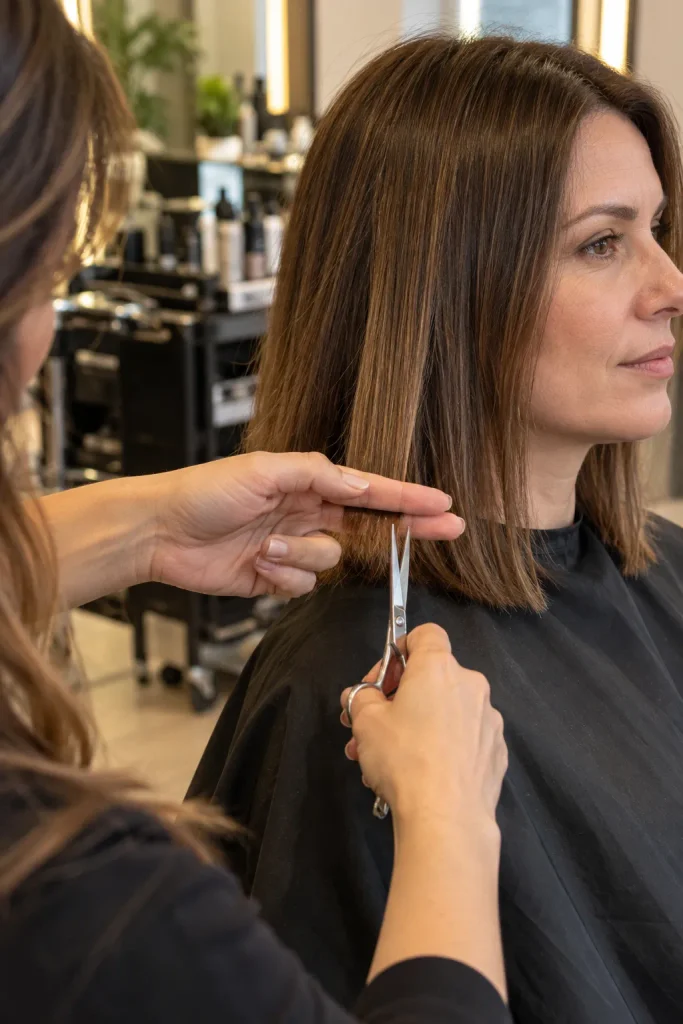
Texturizing refers to cutting techniques that change how the hair’s ends and internal weight behave.
Your stylist might texturize a haircut to soften a hard line, remove excess bulk, or create more separation between sections.
But the word texturizing is broad.
Different techniques can produce very different results.
That’s why it’s useful to ask what your stylist specifically intends to do.
Point Cutting
Point cutting involves using the tips of the scissors to cut into the ends rather than cutting straight across them.
It can soften a blunt edge or introduce subtle texture.
The result depends on how deeply the stylist cuts and how much hair they remove.
A little point cutting may barely change the outline.
More extensive point cutting can create a noticeably softer, less solid finish.
Slide Cutting
Slide cutting involves guiding partially open scissors along a section of hair.
A stylist may use the technique to blend lengths, create movement, or remove weight.
Because the method changes how hair is distributed within a section, it requires control and an understanding of the hair’s condition.
Razor Cutting
Razor cutting uses a specialized cutting razor rather than conventional haircutting scissors.
A stylist may choose it to create a softer, feathered finish.
However, not every hair type or condition responds equally well.
Fragile, damaged, or certain highly textured hair types may require particular caution.
Ask your stylist whether a razor is appropriate for your hair and what visual difference it will create.
Thinning Shears
Thinning shears have a toothed blade that removes some strands within a section.
They’re commonly used to reduce or blend bulk.
However, removing too much hair can leave certain cuts looking sparse or difficult to control.
For fine or lower-density hair, discuss whether thinning is necessary before agreeing to it.
Texturizing Versus Thinning
Texturizing can soften ends or modify the haircut’s internal structure.
Thinning generally focuses on reducing bulk.
Some methods overlap, and stylists may use the terms differently.
The most useful question is:
“Are you softening the ends, removing bulk, or changing the layers?”
That tells you much more than the word texturizing alone.
What Is the Perimeter of a Haircut?
The perimeter is the outer boundary or visible cutting line of the hairstyle.
In longer cuts, this includes the shape formed by the ends around the back and sides.
In short haircuts, the outline around the ears and neckline also becomes important.
Common perimeter shapes include straight, rounded, V-shaped, and U-shaped designs.
Straight Perimeter
A straight perimeter creates a relatively even-looking line across the bottom.
It can look defined and structured.
U-Shaped Perimeter
A U-shaped cut has a gently rounded outline when viewed from behind.
The hair usually appears longer toward the center and shorter toward the sides.
V-Shaped Perimeter
A V-shaped cut has a more pointed outline at the back.
The center remains longer while the sides move upward toward the point.
Why the Perimeter Matters
Imagine asking for long layers without discussing the shape of your ends.
You might want soft movement but still prefer a full-looking bottom edge.
Your stylist may interpret the request differently.
A clearer instruction would be:
“I’d like long layers, but I want to keep a soft U-shaped perimeter rather than a very pointed V.”
This combines the type of layering with the finished outline.
What Does Elevation Mean During a Haircut?
Elevation describes the angle at which a hairstylist lifts a section of hair away from the head while cutting it.
It influences how length and weight are distributed.
For example, cutting hair in its natural falling position creates a different result from lifting it upward before cutting.
Hairstylists use elevation as part of designing blunt, graduated, and layered haircuts.
You don’t need to memorize cutting angles.
The important point is that lifting and cutting hair at different positions changes the shape of the finished haircut.
If a stylist mentions elevation, ask what effect it will create.
A useful question is:
“Will that give me more layers, build weight, or remove weight from the ends?”
Overdirection: Why Your Stylist Pulls Hair Away From Its Natural Position
Overdirection is a cutting technique in which the stylist moves a section away from where it naturally falls before cutting.
This allows them to control where length and weight remain.
For example, a hairstylist may direct front sections backward to retain more length toward the face.
The exact result depends on the cutting pattern and technique.
Overdirection isn’t a haircut style by itself.
It’s one of the tools a stylist uses to create the intended shape.
You don’t need to request a particular overdirection technique unless you’re discussing the technical details with your stylist.
Instead, explain where you want the hair to remain longer.
A Haircut Glossary: 20 More Terms You’ll Hear at the Salon
The following terms appear frequently in hairstyle descriptions and salon conversations.
1. Lob
A long bob, usually falling somewhere around the shoulders or collarbone.
2. Pixie
A short haircut with relatively cropped sides and back, often leaving more length on top.
3. Shag
A haircut featuring noticeable layering and a textured silhouette. Many shags include a fringe, although it isn’t essential.
4. Wolf Cut
A layered haircut often combining shorter, fuller sections around the crown with longer, lighter lengths below.
5. Butterfly Cut
A long layered style with shorter face-framing sections and longer lengths underneath. It often creates the appearance of multiple lengths.
6. A-Line Bob
A bob with longer front sections and shorter sections toward the back, forming an angled outline.
7. Inverted Bob
A bob that’s shorter at the back and longer toward the front. Depending on the design, it may include graduation or stacking.
8. Asymmetrical Cut
A haircut intentionally designed with different lengths or shapes on opposite sides.
9. Undercut
A haircut where the hair underneath is cut much shorter than the longer sections above it.
10. Taper
A gradual transition between shorter and longer hair, commonly used around the neckline and sides.
11. Fade
A closely blended transition between very short lengths. It is commonly used in cropped and clipper-based haircuts.
12. Fringe
Hair cut to fall across or around the forehead. Also called bangs.
13. Curtain Bangs
A fringe usually parted near the center, with sections framing both sides of the face.
14. Wispy Bangs
A light, separated fringe that allows some forehead visibility.
15. Choppy Layers
Layers designed to create a more visibly separated, piecey appearance.
16. Feathering
Softening the ends or transition between sections to create a lighter-looking finish.
17. Weight Line
The area where the haircut’s length creates a visible concentration of weight or fullness.
18. Crown
The upper area toward the back of the head, often near a natural swirl in the growth pattern.
19. Nape
The lower back of the head where the hair meets the neck.
20. Cowlick
A section of hair that naturally grows in a different direction from the surrounding strands.
Cowlicks can influence how short haircuts, fringes, and crown layers sit.
Three Haircut Terms That Often Get Confused
Understanding these distinctions can prevent unnecessary disappointment.
| Terms | Key Difference |
|---|---|
| Blunt cut vs. layered cut | A blunt cut emphasizes a defined cutting line; layers introduce different lengths |
| Graduation vs. layering | Graduation typically builds weight in a structured progression; layering redistributes or removes weight |
| Texturizing vs. thinning | Texturizing changes movement or the finish of the ends; thinning specifically reduces bulk |
There’s another important distinction: the haircut and the hairstyle aren’t always the same thing.
A bob is a haircut shape.
A sleek blowout is a styling finish.
You can wear the same bob sleek, wavy, tousled, or curled without changing the underlying cut.
This matters when choosing reference photographs.
If you love a picture because of the styling, a new haircut may not be necessary.
How to Describe the Haircut You Want Without Using Technical Language
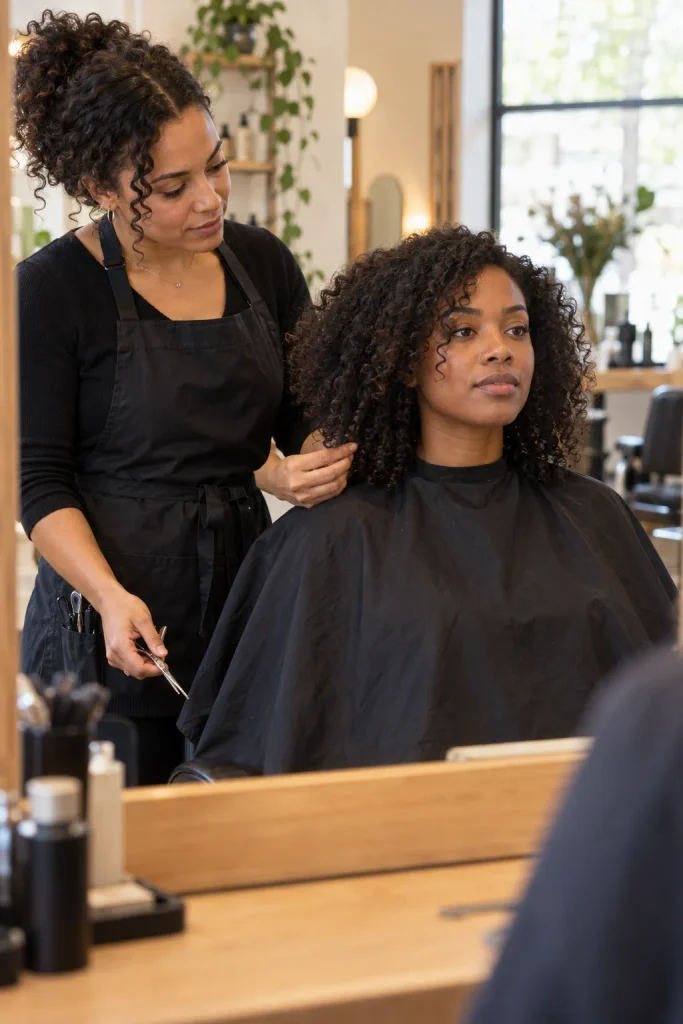
Knowing salon terminology is helpful, but you don’t have to speak like a professional hairstylist.
Clear descriptions often work better than using technical words you’re unsure about.
For example, consider these requests.
Instead of “I want layers”
Try:
“I want movement through the lower half of my hair, but I don’t want noticeably short pieces around my crown.”
This tells your stylist where you want the layers and where you don’t.
Instead of “Thin my hair out”
Try:
“My hair feels bulky around the sides. Can you show me how we might adjust the shape without making the ends look sparse?”
This leaves room for the stylist to consider different techniques.
Instead of “Give me a textured bob”
Try:
“I want a bob with a soft, slightly separated finish rather than a sharp, solid cutting line.”
This describes the appearance you’re hoping to achieve.
Instead of “Just take off the dead ends”
Try:
“I’d like to keep as much length as practical. Can you show me exactly how much you recommend removing before you cut?”
This avoids relying on an unclear definition of what counts as damaged ends.
Instead of “I want a short haircut”
Try:
“I want the hair to fall just below my chin when dry, and I’d like enough length at the front to tuck it behind my ears.”
That gives the stylist a visible target and a practical requirement.
Why Reference Photographs Can Still Lead to Misunderstandings
A photograph is useful, but it doesn’t explain everything about a haircut.
You might admire the shape without realizing that the model has thicker hair, extensions, or a professionally styled finish.
Sometimes the photograph shows a layered haircut arranged to look like a blunt cut.
Other times, the visual volume comes mainly from blow-drying or curling.
Before your stylist begins, identify what you actually like about the photograph.
Is it the length?
The fullness around the crown?
The way the ends frame the face?
The fringe?
The overall texture?
It’s worth bringing more than one image when possible.
Choose a photograph of the front, side, and back.
If you can find an example with a hair texture similar to yours, that’s especially helpful.
Five Decisions to Make Before the First Cut
You don’t have to design the entire haircut yourself.
However, there are five details worth agreeing on before the stylist starts.
1. The Finished Length
Agree on where the hair should fall when dry.
This is particularly important for curls, waves, and hair with noticeable shrinkage.
2. The Amount of Layering
Discuss whether you want subtle movement, prominent layers, or a relatively solid shape.
Ask where the shortest layers will begin.
3. The Perimeter
Decide whether you prefer a blunt, rounded, angled, or tapered outline.
4. The Fringe
If you want bangs, agree on their shortest point, density, and styling needs.
5. The Maintenance
Ask how the haircut will behave when air-dried, how often it may need reshaping, and how much daily styling it requires.
These decisions are more valuable than memorizing dozens of cutting techniques.
What to Say When You Don’t Understand a Salon Term
It’s completely reasonable to ask your stylist to explain what they’re proposing.
You can say:
“Could you show me what that technique will change about the finished haircut?”
Or:
“Will that remove length, reduce bulk, or change the shape?”
If the stylist suggests thinning or texturizing, ask where they’ll use the technique.
If they recommend layers, ask where the shortest layer will fall.
If they suggest graduation, ask whether the finished shape will look stacked or softly rounded.
A professional consultation should help you understand the haircut before you agree to it.
You don’t need to pretend you understand every technical term.
Haircut Terminology for Different Hair Types
The same cutting technique may create different results depending on hair characteristics.
Fine Hair
A blunt perimeter may create the appearance of fuller ends.
However, fine hair can also benefit from carefully placed layers when movement is needed.
If your density is relatively low, discuss how much hair will remain around the bottom after layering or texturizing.
Thick or High-Density Hair
A stylist may suggest internal layers, weight removal, or graduation to manage the shape.
Ask whether the technique will change the outer appearance or mainly reduce bulk within the haircut.
Wavy Hair
Layers may influence where waves form and how much width develops around the sides.
Reference photographs showing natural waves can help your stylist understand the silhouette you want.
Curly and Coily Hair
Shrinkage, density, and the way curls fall are important when planning the finished length.
A cut performed on stretched or wet hair may look different once the hair returns to its natural pattern.
Ask how your stylist will account for this.
Fragile or Damaged Hair
Hair condition may influence which cutting and styling methods are appropriate.
If your hair is breaking easily, discuss this before the appointment.
The American Academy of Dermatology recommends gentle handling, limiting excessive heat, and avoiding prolonged tension that can contribute to damage.
Common Questions About Haircut Terminology
What does texturizing mean in a haircut?
Texturizing refers to techniques that alter the distribution of weight or soften the ends. A stylist might use point cutting, slide cutting, or other methods, depending on the intended result.
What’s the difference between a blunt cut and layers?
A blunt cut produces a strong, defined perimeter. Layers create sections of different lengths, which can change movement and weight distribution.
What does graduation mean in a haircut?
Graduation is a technique that transitions from shorter to longer hair and often builds weight into a structured shape, such as the back of a stacked bob.
Does texturizing remove hair?
Yes, many texturizing techniques remove some hair. The amount depends on the method and how extensively it is used.
What does keeping the weight mean?
It generally means preserving a concentration of hair in a particular area, often to maintain a fuller-looking perimeter or structured silhouette.
Can I ask for layers without losing much length?
Yes. You can retain most of your overall length while introducing shorter sections. However, layers still involve cutting some hair shorter, so agree on their placement beforehand.
Is razor cutting better than scissor cutting?
Neither is automatically better. They produce different finishes, and suitability depends on hair texture, condition, cutting technique, and the desired result.
What should I tell my stylist if I don’t know any haircut terms?
Describe the length, shape, and appearance you want. Use photographs, explain your daily routine, and ask the stylist to clarify unfamiliar techniques.
The Most Useful Salon Skill Is Knowing What to Ask
You don’t need to understand every cutting angle or know how to use professional scissors.
What matters is recognizing the differences between length, layers, weight, perimeter, and texture.
Once you understand those basics, you can look at hairstyle photographs more carefully and explain what attracts you to a particular cut.
A blunt bob, a layered lob, and a graduated bob might all be described as short hairstyles, but they create different silhouettes.
Learning the terminology helps you understand those differences before committing to one.
When a stylist mentions a technique you don’t recognize, ask what it changes and how the result will look on your hair.
The goal isn’t to direct every movement of the scissors.
It’s to make sure you and your hairstylist are working toward the same finished haircut.
Editorial note: Haircut terminology may vary between salons and training systems. The definitions above explain common professional usage, but the precise result depends on the hairstylist’s technique, the haircut design, and your natural hair characteristics.

Gayathri Arun is the founder and editor of GlowNStylish, where she shares hairstyle inspiration, practical hair care guides, outfit ideas, and nail trends. Passionate about making style advice useful and approachable, she focuses on the little details that matter—from hair texture and face-framing layers to styling techniques and everyday maintenance. Her goal is to help women look beyond inspiration photos, understand their options, and confidently choose styles that suit their hair, lifestyle, and personal preferences.